
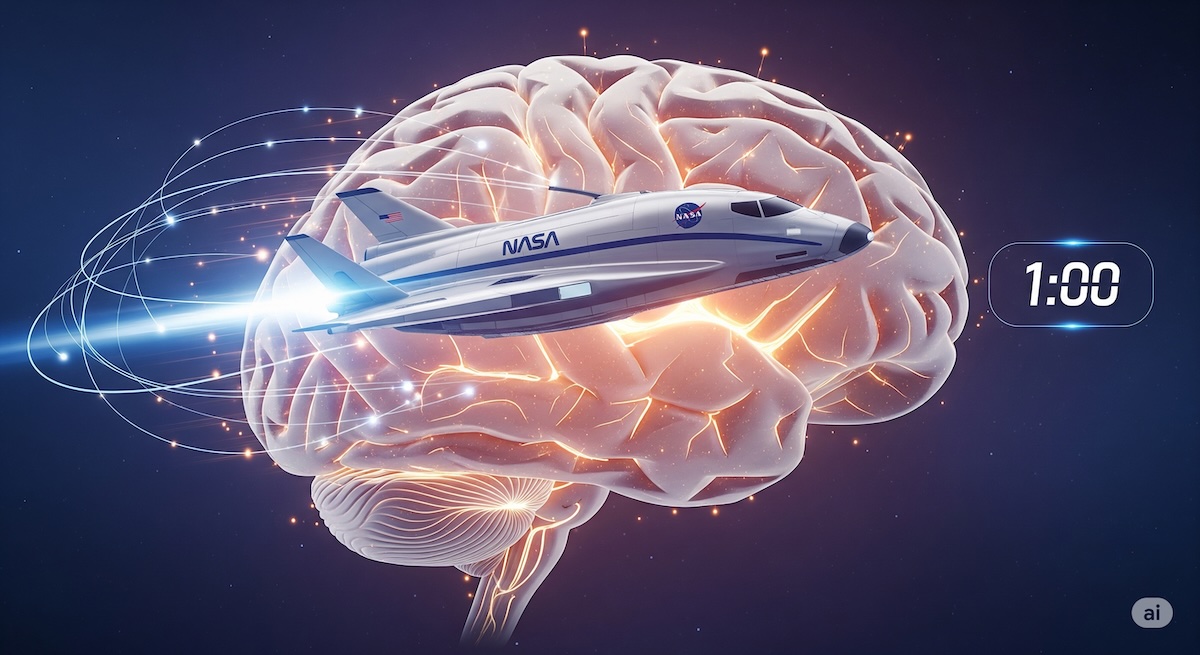
NASA's 1-Minute Brain Savers for Spiritual Enrichment (Scientifically Proven)
Are you feeling the squeeze of daily stress? Wish you could hit the reset button on your focus and mental clarity? What if we told you that the brilliant minds at NASA have developed ingenious, quick-fire exercises, grounded in cutting-edge neuroscience, designed to do just that? Get ready to unlock your brain's full potential and discover simple, effective ways to reduce stress and sharpen your focus – all in just 60 seconds! That's right! You can't claim you don't have enough time to try these! Each one takes only 60 seconds ... that's one minute ... to perform! You can do it! Are you ready for take off? Here we go!
Think of your brain as a spaceship navigating the vast universe (or as we like to say, YOUniverse) of thoughts. Sometimes it needs a quick pit stop to refuel and realibrate. These activities, all suggested and tested by NASA engineers, are designed to save your brain, relieve stress, and improve your focus. For fun, we've given them names to fit the theme of Nasa Space Travel!
Cosmic Breathing [Officially used by NASA]

Benefit: This exercise helps reduce anxiety and increases focus, much like a quick tune-up for your mental spaceship.
Deep breathing exercises can help calm the nervous system by activating the parasympathetic response, which reduces stress hormones. Cosmic Breathing is a technique that uses a series of
4-counts. (This is also used by Navy SEALS, and is known as Box Breathing).
Here's How:
1. Sit comfortably and close your eyes.
2. Inhale deeply through your nose for a slow count of four, imagining you're drawing in stardust.
3. Hold your breath for a slow count of four, letting the stardust settle.
4. Exhale slowly through your mouth for a slow count of four, releasing any tension.
5. Sit quietly to a slow count of four, enjoying the inner calmness.
5. Repeat for one minute.
Every sixty seconds is a new launchpad. Choose to lift off from stress and ascend into clarity. (Gemini AI)
Gravity Release [Officially used by NASA]
We renamed it as Gravity Release; however, NASA calls it Progressive Muscle Relaxation (PMR), and includes it in astronaut training protocols as well as recommending it for use in space. It's especially useful before sleep or to reduce physical manifestations of stress. This is Included in psychological support kits (PSKs) for long-duration missions.
Here's How:
1. Imagine tension melting off your body like gravity loosening its grip.
2. Start from your toes and move upward.
3. Tense each muscle group for 5 seconds, then relax.
4. Release your muscles, reclaim your lightness.

Benefit: This practice helps release tension and improves body awareness.
What can we gain by sailing to the moon if we are not able to cross the abyss that separates us from ourselves? (Alan Watts)
Inner Stargazing [Officially used by NASA]

Benefit: This exercise supports emotional resilience and focus.
You'll recognize this technique by its more well-known name, Visualization/Mental Imagery.
NASA uses visualization techniques to help astronauts rehearse tasks and mentally prepare for challenges. This is especially useful in cognitive rehearsal and emotional self-regulation. It’s also embedded in their “Self-Guided Stress Management Training” modules.
Here's How:
1. Sit comfortably and close your eyes.
2. Picture a peaceful place or a successful outcome of something you are planning.
3. Engage your senses—what do you see, hear, feel?
4. Enjoy the visualization completely; then slowly breathe back into an awareness of the present moment.
Space travel humbles the ego and awakens the eternal in us — a quiet reminder that we are stardust having a sacred experience. (ChatGPT)
Orbital Focus [Used by NASA Indirectly]
This strategy is commonly known as Mindfulness! NASA doesn’t specifically promote "mindful object observation" per se, but they do support mindfulness practices and focused attention training to increase awareness, decrease rumination, and enhance task performance. NASA collaborates with psychological experts on incorporating mindfulness in mission-prep.
Here's How:
1. Sit comfortably with eyes open.
2. Choose an object nearby, and spend 45 seconds observing it carefully.
3. Notice its texture, color, shadows, details, and the feeling of how your energy connects with it.
4. close your eyes and capture the image in your mind.
5. Open your eyes and compare your mental image with the real thing. Breathe and relax.

Benefit: This practice increases awareness, focus, and mind reset.
Look at the stars. See their beauty, and in that beauty see yourself. (Draya Mooney)
Galactic Gratitude [Used by NASA Indirectly]

Benefit: Practicing gratitude can rewire the brain to focus on positive experiences, enhancing overall well-being.
Gratitude as a formal practice is not part of NASA's core astronaut training, but positive psychology strategies (including journaling, connecting with meaning, and emotional reframing) are part of support programs for astronaut well-being. Some astronauts do engage in this personally during long missions, and it’s consistent with the emotional regulation tools NASA endorses.
Like astronauts looking back at Earth from space, reflect on the beauty, kindness, and blessings that illuminate your world.
Here's How:
1. Take a moment to think of three things you're grateful for, as if you're collecting cosmic treasures.
2. Write them down or say them aloud, visualizing each as a shining star in your personal galaxy.
3. Reflect on how these stars light up your universe.
The little space within the heart is as great as the vast universe (Kalpana Chawla)
Out of This World Laughter [Used by NASA Indirectly]
This strategy is commonly known as Laughter Yoga or a Laughter Meditation. While Laughter Yoga itself isn't explicitly listed as a standard NASA-developed stress relief technique in the same way as, say, progressive muscle relaxation, humor is definitely recognized and used by astronauts. NASA studies and astronaut accounts indicate that humor is a crucial in-flight psychological countermeasure. It's used to improve teamwork, reduce stress, diffuse tense situations, and improve astronauts' emotional states during spaceflight and in other isolated, high-pressure environments.
Laughter Yoga, developed by Dr. Madan Kataria in 1995 in Mumbai, India, is a unique exercise routine that combines unconditional laughter with yogic breathing (Pranayama). The concept is based on the idea that the body cannot differentiate between fake and real laughter, so even if you're faking it, you can still reap the physiological and psychological benefits.We can use Out of This World Laughter to relieve stress and build community through shared joy. It's best done with others!
Here's How:
1. Start with gentle warm-up techniques, which include stretching, chanting, clapping, and body movement. These help break down inhibitions and encourage playfulness.
2. Follow this with a series of laughter exercises that are interspersed with deep breathing exercises to help flush the lungs and bring more oxygen into the body. Basically, just start laughing ... once you start, it keeps growing!

Benefit: A metaphor often used in Laughter Yoga is that laughter is like a gentle internal jog, providing a workout for your insides without the need for running shoes. It's a fun and effective way to enhance mental and physical health, plus, it's a great way to connect with others and build a sense of community through shared joy and laughter.
I checked out a book on antigravity. I can't put it down! (weareteachers.com/space-jokes/)
A Final Reminder:
As we journey through the cosmos of our inner world, these NASA-inspired, neuroscience-backed exercises aren't just about managing stress or sharpening focus – they are launchpads for profound spiritual exploration. By consciously engaging with your mind and body, you're not merely practicing a technique; you're awakening your inherent capacity to walk the Spiritual path on positive, practical, prosperous feet. So, take these minute-long missions, and discover how truly expansive your spirit can become!